


On January 15, the paper titled "Beyond geometry orders: uncovering bonding heterogeneity dominated structure-relaxation coupling in glasses" by the research team led by Professor Yu Haibin from the National Pulsed High Magnetic Field Science Center was published online in the National Science Review (NSR). Our university is the first completion unit of the paper. Gao Liang, a 2022 doctoral student from the Strong Magnetic Field Center, is the first author of the paper. Professor Yu Haibin, Professor Jeppe Dyre from Roskilde University in Denmark, and Researcher Wang Qi from the Institute of Materials Research, China Academy of Engineering Physics, are co-corresponding authors. Professor Sun Yang from Xiamen University, Professor Kai-Ming Ho from Iowa State University in the United States, as well as 2022 master's student Gao Jiaqi, 2021 doctoral student Bu Qingzhou (graduated), and postdoctoral researcher Yang Qun (completed postdoctoral work) from the Center participated in the related research work.
Amorphous materials (or glasses) are widely used in structural materials, functional devices, and engineering fields, serving as important research subjects in materials science and condensed matter physics. Unlike crystalline materials with well-defined long-range ordered structures, amorphous materials exhibit high disorder at the atomic scale. Their physical properties are highly sensitive to preparation history and external conditions, displaying a series of complex and unique dynamic behaviors.
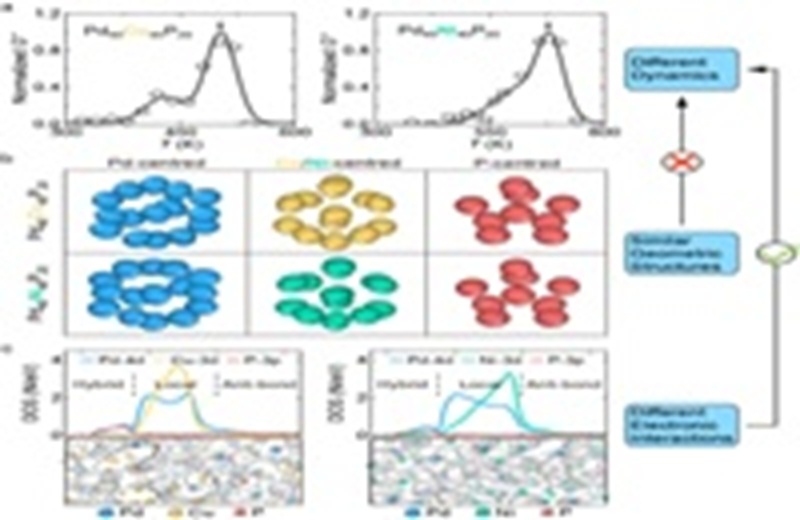
Relaxation Dynamics Determined by Heterogeneity in Electronic Interactions
For a long time, research on the structure-property relationship of amorphous materials has mainly relied on geometric structural analysis methods, such as local coordination environments, atomic arrangement patterns, and short- and medium-range ordered structures. While these methods have revealed common features of amorphous structures to some extent, practical studies have gradually shown that descriptions based solely on geometric structure often struggle to explain the significant differences in the dynamic behaviors of amorphous materials. Particularly in multi-component metallic glass systems, materials with similar compositions and structures often exhibit vastly different dynamic behaviors and thermal stability, posing new challenges to traditional structural analysis methods.
Addressing this scientific issue, the Yu Haibin team systematically compared the differences in thermal behavior and relaxation dynamics between two Pd-based glass materials, Pd40Cu40P20 and Pd40Ni40P20, through experimental characterization and advanced deep learning molecular dynamics simulations. The study found that although the two systems are highly similar in atomic geometric structure, their relaxation and glass-forming abilities differ significantly. Further analysis revealed that this difference does not stem from traditional structural arrangements and order but is closely related to the chemical bonding characteristics within the materials. The research results indicate that the heterogeneity in the strength and spatial distribution of Cu-P and Ni-P chemical bonds in the two systems significantly affects atomic mobility and cooperative rearrangement, thereby regulating the dynamic behaviors of amorphous materials. This discovery suggests that chemical interactions play a non-negligible, and in some systems even a dominant, role in the dynamics of amorphous materials.
This research breaks through the traditional analytical framework centered on geometric structure, providing a new physical perspective for understanding the dynamic behaviors of amorphous materials from the angles of chemical bonding and electronic structure. It not only deepens the understanding of the relaxation mechanisms in metallic glasses but also offers new theoretical foundations for performance regulation and novel material design of amorphous materials.
This research work was supported by the National Natural Science Foundation of China, the computing platform of Huazhong University of Science and Technology and the Strong Magnetic Field Center, the Sichuan Provincial Natural Science Foundation, the China Postdoctoral Science Foundation, and the VILLUM Foundation of Denmark.
Stainless steel coil applications and precautions for use
2021-09-22Influence of lamination iron core size on magnetic properties of motor
2023-12-23The Process and Classification of Silicon Steel
2025-10-16The Role of Important Alloying Elements of Austenitic Stainless Steel (Part2)
2021-07-27Laser and Innovation Lead New Trends in the Silicon Steel Market
2025-11-07The Application and Development Trends of High-Performance Silicon Steel in Transformer Cores
2024-12-17